“Online spaces are constructed and the activities that people do online are intimately interwoven with the construction of the offline world and the activities and structures in which we participate, whether we are using the Internet or not”. Thus, online lives exist in complicated relationship to offline lives and to what has been termed the “outernet”. (Poletti and Rak 2014,)
But it’s also something that happens to us after we post or share something on social media platforms. For example, by creating a blog or Posting on Facebook or sharing photographs via Instagram effects our offline life as well.
With this Blog, I’ll try to figure out my overall construction of an online identity across several social media sites and recall some experiences relating to my online identity.
I use Facebook, Twitter, Instagram and Snapchat for my social media activity. And there is no doubt in that, “My offline life plays a role in constructing my online life or online identity.
For instance, this picture below, I shared on my Facebook Profile when I completed my one year in Melbourne, Australia.
But that’s not how I react on every social media platform.
Unlike Facebook, I share some news or my professional work on my twitter ID. The below post I tweeted when I heard the news about a famous film director Anurag Kashyap from India was conducting a Masterclass at our Deakin University.
I work for an Indian Radio station here in Melbourne as a Radio DJ and I interview Indian Actors/ Celebrities. To, showcase my work to people and to reach those celebrities I tweet my interview links.
On 7th May 2017, I tweeted a Youtube link of my interview with India Superstar Salman Khan about his latest release Tubelight.
Kim Barbour and David Marshall’s (2012) categorised different kind of academic persona. These categories are Formal Self, Networked Self, Comprehensive Self, Teaching Self and uncontainable self.
| Table 1: Features of the five main types of academic persona. | ||||
| Formal self | Networked self | Comprehensive self | Teaching self | Uncontainable self |
| Broadcast style
Fixed presentation Focus on achievements and expertise Framed through the institution |
Narrowcast
Interactive Professional Extra–institutional Multi–platform |
Narrowcast
Interactive Professional and private blurred Extra–institutional Multi–platform |
Targeted
Interactive and collaborative Professional Inter/Intra/Extra–institutional |
Uncontrolled
Unmonitored Multi–platform |
When I tried to reflect my online identity I created these following categories for my different social media identities.
Formal (Twitter) > Semi Formal (Instagram) > Semi Informal (Facebook) > Informal (Snapchat).
The below Easel.ly infographic, I made to symbolically capture or categorized some of the connections I make between my online identity(s):
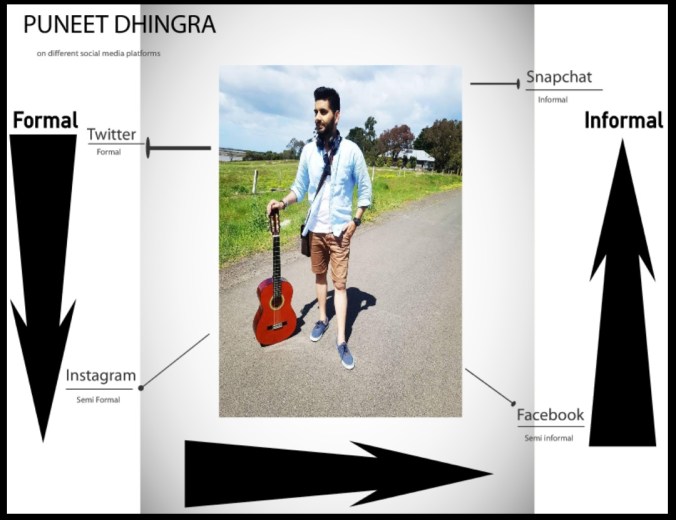
If I talk about my Instagram profile. It is a kind of mixture of my Twitter & Facebook Identities. On Instagram, I try not to act too professionally as I do on twitter. Rather I keep a balance between my professional and private life.
For example the below photo posted on my Instagram was from year 2016 when in Melbourne Central I was giving free hugs.
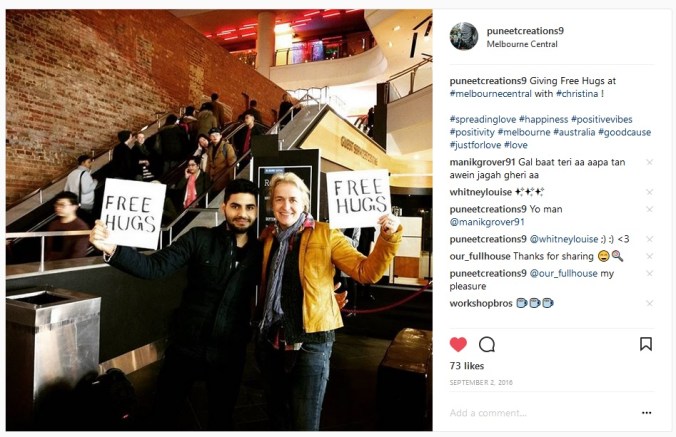
By this photo I tried to tell people that I am involved in some kind of social work as well.
On Facebook I care more about my original or offline identity (My Good Side). I share my best featured pictures on Facebook. I write some opinions or my views about ongoing trends. Because, on my FB profile I have followers who know me in real life as well. I share my friends’ posts on my wall so that their posts would make an impact.
I share some of my High points of life as I did in the below post:
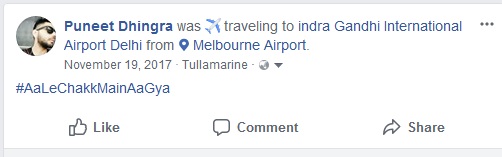
Screenshot of my facebook wall, 19th Nov. 2017
But on Snapchat I ultimately lack control over what I share or post. I think snapchat is a very informal tool of social media and very easy to use and post videos or photos. Just hold record button and post whatever or whenever you want. And, that’s what I do. Like (Poletti and Rak 2014,) mentioned, “Online lives exist in complicated relationship to offline lives”
And couple of time, snapchat stories effected my offline life, as one day I took off from my work and told them I was sick. But my colleagues saw my snapchat story of me and my friends drinking and you can imagine the result. Poor Me 😦
An article published in Dailymail stated that “Two-thirds of those who use the social networking website say they have ‘unfriended’ somebody they do not want to know any more. Another 44 per cent deleted comments made by other people on their profile page and 37 per cent removed tags of themselves from photos. “
I am hoping to do the same. As of now, on my facebook I have plenty of people who I don’t know personally. Moreover, most of the posts I made on Facebook were public. I’ll try to keep posts private or only share with friends, when it’s about my personal life.
References:
Smith, S and Watson, J 2014, ‘Virtually Me: A Toolbox about Online Self -Presentation’, in Poletti, A and Rak, J, Identity Technologies: Constructing the Self Online, the University of Wisconsin Press, Madison, retrieved 14th April 2018, < https://ebookcentral-proquest-com.ezproxy-b.deakin.edu.au/lib/deakin/reader.action?docID=3445384&query= >
Barbour, K and Marshall, D 2012, ‘The academic online: constructing persona through the World Wide Web’, First Monday: Peer-reviewed Journal of the Internet, vol. 17, no. 9, 3 September, retrieved 15 April 2018, < http://journals.uic.edu/ojs/index.php/fm/article/view/3969/3292>
Bates, D 2012, The anti-social network: Two-thirds of Facebook users are pruning their friends list to be more selective, Daily Mail, 27 February, retrieved 14th April 2018, < http://www.dailymail.co.uk/news/article-2106745/Facebook-Two-thirds-users-pruning-friends-list-selective.html >
 Puneet creations